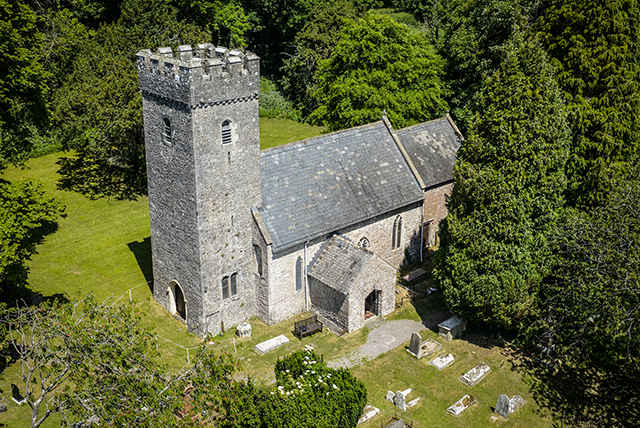
Dedication — St Illtyd, the sixth-century abbot of Llanilltud Fawr (Llantwit Major), the most influential of the early Glamorgan saints.
Listing — Grade II* (Cadw ref. 13609, listed 28 January 1963), cited as "a good example of a restored medieval church with an outstanding monument to the Bassett family".
History — Twelfth-century origins. Chancel, nave and the heavily battered tower were rebuilt in the fourteenth century. The tower was repaired in the eighteenth century, when a west gallery was inserted. In 1897 John Prichard, the Llandaff diocesan architect, restored the church extensively: the gallery and rood loft were removed, the south porch rebuilt, and the building re-floored, re-pewed and re-fenestrated.
Notable features — The fourteenth-century chancel arch with continuous mouldings, and the late medieval rood screen. The east window is dated 1656, an unusual survival from the Commonwealth years. The south porch retains an early sixteenth-century moulded principal rafter and a battlemented wallplate with carved foliage. South of the tower is a carved fragment of about 1200 with blind arcading — font-shaped, but more likely the base of a medieval cross.
In the chancel is an exceptionally fine late sixteenth-century Renaissance monument to John Bassett and his wife with Sir Anthony Mansell and his wife Elizabeth, Bassett’s younger daughter, surrounded by their seven children; it is attributed to the Glamorgan carver Richard Twrch. The nave holds further Aubrey, Bassett and Mansel monuments.
Local interest — The ruins immediately south-west of the churchyard are Llantrithyd Place, built about 1546 for John Thomas Bassett, Sheriff of Glamorgan. It passed by marriage to the Mansels, and in 1586 to the Aubreys, when Mary Mansel married Thomas Aubrey. The Aubreys were made baronets of Llantrithyd in 1660 and held the estate for the next two centuries.
The direct line ended with a child’s death. Sir John Aubrey, 6th Baronet (1739–1826), a Member of Parliament for more than fifty years and Father of the House when he died, had one son, born in December 1771. The boy died of accidental poisoning on 2 January 1777, aged five. No further son was born. On Sir John’s death the baronetcy and the entailed Llantrithyd estate passed to a nephew, Sir Thomas Digby Aubrey, who had no children, never lived here, and left the house to decay; the title became extinct on his death in 1856.
The grounds have survived better than the house: a sixteenth-century terraced garden with ponds, walks and a raised walk up to a look-out mount, and an exceptionally complete walled deer park of the mid-seventeenth century, registered Grade II*.
Cecil Aubrey, daughter of Sir Thomas Aubrey of Llantrithyd, married Judge David Jenkins of Hensol — connecting this parish directly to Pendoylan’s.