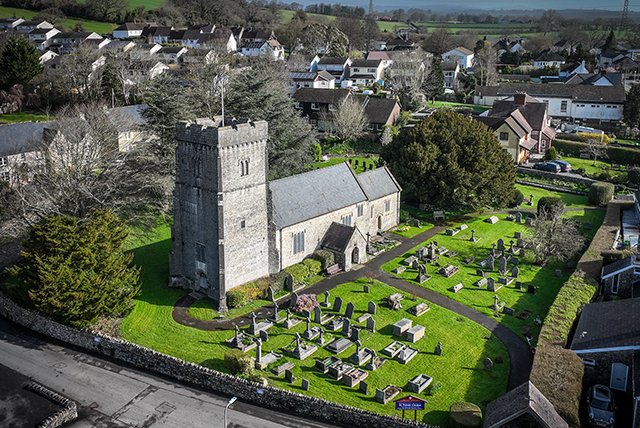
Dedication — St Peter; the Welsh name, Llanbedr-y-fro, carries the same dedication.
Listing — Grade II* (Cadw ref. 13618, listed 28 January 1963), listed "as substantially retaining medieval character and masonry".
History — The first documentary reference is in the Valuation of Norwich of 1254. The masonry is mostly Perpendicular and the building dates chiefly from the fifteenth century, though the chancel arch is earlier — probably fourteenth century — and the tower appears to have been designed separately from the nave. Kempson and Fowler restored the church in 1890, working substantially on the chancel. The churchyard was cleared in the nineteenth century, as the exposed roots of the older yews show.
Notable features — A sturdy west tower with stepped corner buttresses, corner gargoyles and an embattled parapet, housing a ring of six bells originally cast at Chepstow in 1717. The south porch retains a medieval arch-braced truss with a heraldic boss and stone side benches. Nave and chancel keep Perpendicular cinquefoil-headed windows in square frames, and the two doorways that gave access to the rood loft survive beside the chancel arch. Inside are a six-bay arch-braced nave roof, a small later medieval font with a tall nineteenth-century tabernacle cover, an east window of 1891 by A. Savell, and an oak screen of 1947 in memory of the Vaughan family.
Local interest — St Peter’s is the church seen in Gavin & Stacey. It stood in for Nessa and Dave’s wedding — the one abandoned at the altar — and for baby Neil’s christening. Gavin and Stacey’s own wedding was filmed a few miles west, at St Cattwg’s, Llanmaes, a point most visitors get wrong.
The village grew up where the old track from Llandaff to the monastic sites at Llantwit Major and Llancarfan crossed the Ely. In 1528 John Leland, touring Wales for Henry VIII, described "Llanpedr on the east bank of the Eley" as a poor village with a stone bridge of three arches. The present Pont Llanbedr, of two main arches with a smaller span over the former millrace, was built in 1869 by Thomas Miller, whose name is inscribed in a roundel on the wall.
A short stretch of wall between two houses is all that remains of Peterston Castle, built by the Norman lords of the manor, the Le Sor family, in the mid-thirteenth century and destroyed by Owain Glyndŵr’s forces in 1403.
The lychgate was erected in 1922 in memory of the men of the parish who died in the Great War.