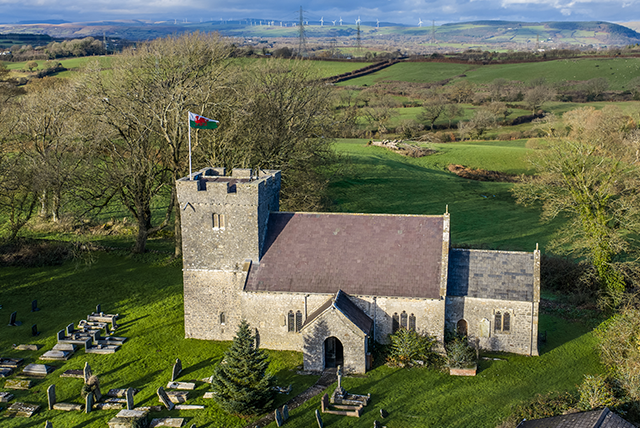
Dedication — St Dunwyd, anglicised as Donat. The Welsh name preserves the original form; "Welsh St Donats" is first recorded in 1482, to distinguish the parish from the coastal St Donats near Llantwit Major.
Listing — Grade I (Cadw ref. 13641, listed 28 January 1963), highly graded "as a fine medieval church with very high quality timber roofs and other features".
History — First mentioned in 1173, and in about 1180 as Capella Sancti Donati, a chapel confirmed to the Benedictine abbey of Tewkesbury; it remained a chapelry of Llanblethian into the seventeenth century, becoming a parish church in its own right only later. Nothing visible survives from that date, the font being the earliest element. The evidence suggests a fourteenth-century building reworked in the fifteenth, with the roofs firmly datable to around 1500. By 1890 the fabric was reported "unfit for use"; Kempson and Fowler carried out the main restoration, reopened on 14 October 1891. G. E. Halliday made minor alterations in 1907.
Notable features — The medieval roofs are outstanding: a five-bay arch-braced collar-beam roof over the nave with two tiers of curved wind-braces and battlemented wallplates, and a three-bay version over the chancel. The Transitional font is at least partly thirteenth century. Also of note are a benefactions board of 1774, several good eighteenth- and nineteenth-century memorial inscriptions, and Halliday’s pulpit of 1907. The pews have been replaced by chairs.
Local interest — Samuel Lewis, surveying the parish for his Topographical Dictionary of Wales in 1833, wrote that the church "possesses no claim to architectural notice". The roof timbers he overlooked are now the main reason for its Grade I listing.
The benefactions board records local charity in a form common before formal welfare provision. Among the entries is Miss Leysons, who in about 1774 left a rentcharge of £5 a year to be distributed among the poor of the parish — a perpetual annual obligation, painted where the congregation would see it every Sunday.
The 1891 restoration did not settle matters. By 1893 the parish was appealing for funds again: no provision had been made for rainwater, which was seeping in from the parapets and gutters, and work on the tower had been deferred.