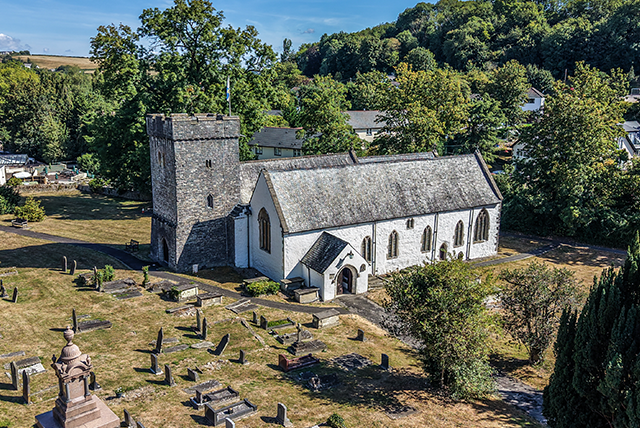
Dedication — St Cadoc, the sixth-century Welsh saint traditionally held to have founded a monastic community here. The place-name is usually translated "church of the stags", after a miracle in which stags did the work of labourers who had refused it, though the derivation is disputed.
Listing — Grade I (Cadw ref. 13605, listed 28 January 1963), cited as "an exceptionally fine example of a parish church with many surviving medieval features".
History — Twelfth-century origins. Nave and chancel were rebuilt between 1284 and 1307 under the patronage of the Abbey of St Peter, Gloucester. In the fourteenth century the south aisle was lengthened, widened and raised to form the Raglan Chapel, and the west tower was built. Chancel, nave and Raglan Chapel were re-roofed in the fifteenth century, and the church was restored in 1887–88 with substantial rebuilding of the tower.
Notable features — Fifteenth-century cradle roofs throughout; a Transitional Norman chancel arch on impost blocks with Romanesque decoration; a Norman font with foliate carving; a twelfth-century stoup beside the south door; and sections of the medieval rood screen, with rare carved timber canopies behind the altar.
The church is best known for its medieval wall paintings. On 5 February 2008 conservators Jane Rutherfoord and Ann Ballantyne began removing some twenty coats of limewash from the south aisle wall and uncovered a monumental St George and the Dragon, among the most complete treatments of the subject in Britain. Further work revealed Death and the Gallant — a young man in late fifteenth-century dress led away by a shrouded corpse — and a full sequence of the Seven Deadly Sins. Conservation has continued in phases since.
Local interest — A shield painted above St George carries the arms of the Bawdrip family of Penmark Place, who almost certainly paid for the scheme. The paintings were whitewashed at the Reformation and remained hidden for some 450 years.
Iolo Morganwg — Edward Williams, 1746–1826 — was born at Pen-onn, a farm in this parish. A stonemason, poet and antiquarian, he invented the Gorsedd of the Bards, the robed ceremony still performed at the National Eisteddfod, and forged a large body of supposedly medieval Welsh manuscripts that took scholars a century to unpick.
The earlier monastery stood a little south of the present church; it was raided by the Danes in 998 and reduced by the Normans to an ordinary parish. An oval mound on the site covers a building of the thirteenth or fourteenth century.