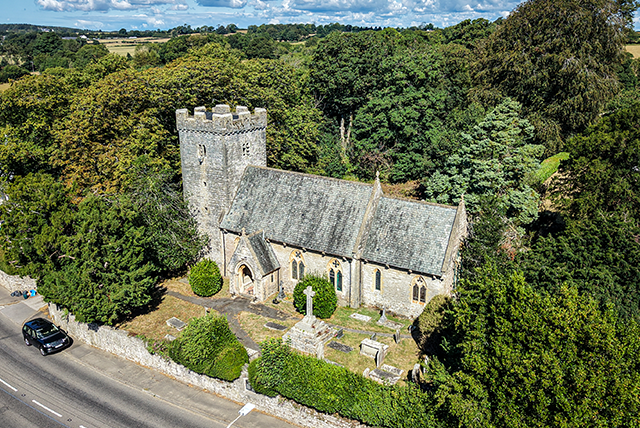
Dedication — St Mary the Virgin.
Listing — Grade II (Cadw ref. 13602, listed 28 January 1963), listed "for its medieval origins and as an example of Prichard and Seddon’s church restoration".
History — Twelfth-century origins, with the tower added in the fifteenth century. By the mid-nineteenth century the church was understood to be ruinous. In 1863 the Cardiff architects Prichard and Seddon reconstructed the nave, chancel, north transept and porch in Early English style, and the building now largely reads as their work.
Notable features — The fifteenth-century chancel arch, of continuous moulding springing from three abbreviated capitals, is the only substantial pre-Victorian internal feature. The small circular font is thirteenth-century in style, with six panels of leaf decoration. On the south-west nave wall is an early carved stone plaque, described by Cadw as a male figure within a rounded arch between vine leaves with a scroll at the base, and long identified in the parish as a panel from a tomb in the style of Adam and Eve. The choir stalls, altar rails, pulpit and lectern were supplied by J. Wippell of Exeter in 1908.
Local interest — The mullions of the belfry windows are understood to have been worked from old headstones; the inscriptions are still legible on them.
The churchyard cross has a four-stepped medieval limestone base and a twentieth-century head of Forest of Dean sandstone. It was restored by public subscription as a memorial to the men of the parish who died in the Great War, to a design by William Clarke of Llandaff, with five names cut into the top step facing south. A further First World War memorial tablet is set into the churchyard revetment wall.
The village name is generally traced to a Norman settler, Simon de Bonville. The English form keeps his surname; the Welsh form, Tresimwn, keeps his first name.