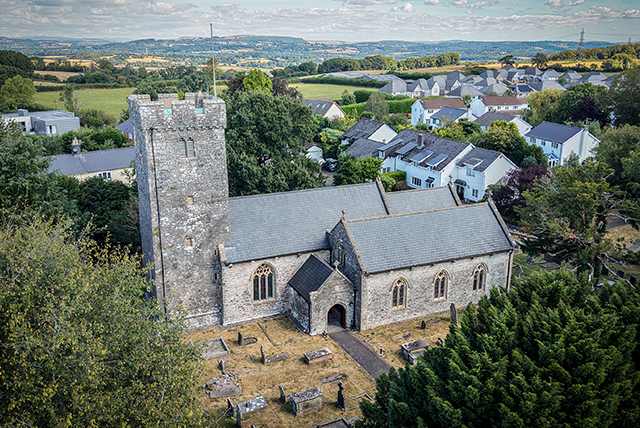
Dedication — St Nicholas of Myra.
Listing — Grade II* (Cadw ref. 13636, listed 28 January 1963), listed "as an example of a substantial parish church of C14 origin with later Victorian re-workings set within the centre of the village".
History — Cadw gives fourteenth-century origins, though the local County Treasures survey argues for an eleventh-century or earlier foundation; the church was valued at £10 in 1254. It comprises chancel, nave, west tower, south porch and south chapel. The south wall of the chapel was rebuilt in 1803 and again in 1859. A heavy restoration and remodelling, completed in 1860, was carried out by Parry of Llandaff to designs by Prichard and Seddon of Cardiff.
Notable features — Fourteenth-century two-light belfry windows with trefoiled heads; an early Perpendicular window in the south-west nave wall with carved heads as label stops; and a Perpendicular south doorway whose outer arch carries a niche with a sundial. The south chapel is floored with ledger tombstones. The font is thirteenth century, a plain octagonal bowl. The pulpit is high Victorian Gothic Revival in coloured marble with a matching flight of marble steps, attributed in the parish to William Burges. The parish also records an iron "tombstone" of 1841. The timber lychgate appears to be by Prichard and Seddon and contemporary with the restoration.
Local interest — The Buttons of Worlton held land in this parish from the fifteenth century. Admiral Sir Thomas Button (d. 1634) commanded the 1612–13 expedition sent to discover what had become of Henry Hudson and to find the North-West Passage. He charted much of the western shore of Hudson Bay, named the Nelson River, and claimed the region as New Wales. He spent the rest of his career pursuing unpaid naval wages and died still owed them. A cul-de-sac of 1950s council houses in the village, Button Ride, carries the family name.
The Corys, Cardiff coal owners, bought the Button and Pryce estate at Dyffryn and rebuilt the house in 1891–93; Reginald Cory’s gardens there are the finest Edwardian gardens in Wales. The family chest tomb stands north-west of the church, in grey Quarella stone, inscribed with the Cory arms and the motto Virtu Sempre Viridis — "virtue always green" — with access to the crypt alongside.
The Corys also reshaped village life. The Three Tuns, a thatched building that served as a magistrates’ meeting house in the reign of Elizabeth I before becoming an inn, was closed by Mr Cory, who considered drink bad for the parish. Miss Cory then built Westways, on the site of the former Traveller’s Rest, as a coffee tavern for travellers and those staying overnight.
The iron "tombstone" of 1841 recorded here is an uncommon survival. Cast iron was cheaper than stone, and from about 1860 a number of foundries took up grave markers as a sideline as demand for their other products fell. In Wales the examples that survive cluster around the ironworking districts. The best known are the five cast-iron grave slabs in St Issell’s churchyard at Saundersfoot, Pembrokeshire, listed Grade II in their own right and made at Davies and Company’s foundry at nearby Coppet Hall between 1874 and 1892. In Breconshire, at Llanelly church near Clydach, sandstone slabs are carried on fluted cast-iron legs probably cast at the Clydach Ironworks, which closed in 1877; the same type recurs at Llangattock. Iron memorials rarely travelled far from the works that made them, which is what makes a marker of 1841 in a farming parish in the Vale unusual — it is both earlier than the main run of Welsh examples and some distance from the furnaces of the heads of the valleys.